Head-up displays

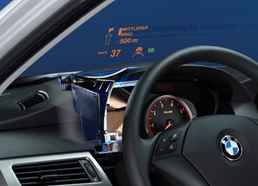
One of the main problems to solve with any automobile instrument or monitoring display is that the driver has to look away from the road to see the information. Also, in other cases, the driver does not look at the display, and therefore could miss an important warning such as low oil pressure. Many techniques can be used such as warning beepers or placing the instruments almost in view, but one of the most innovative is the head-up display (HUD). This was originally developed by the aircraft industry for fighter pilots; aircraft designers had similar problems in displaying up to 100 different warning devices in an aircraft cockpit. Figure 1 shows the principle of a head-up display and figure 2 shows a system in a BMW. Information from a display projector is directed onto a partially reflecting ‘mirror’. The information displayed projected would therefore have to be reversed for this system. Under normal circumstances the driver would be able to see the road through the screen. The brightness of the display is adjusted to suit ambient lighting conditions. A great deal of data can be presented when this system is computer controlled.

A problem, however, is which information to provide in this way. The speedometer could form part of a lower level display and a low oil pressure could cause a flash right in front of the driver. A visual warning could also be displayed when forward-facing radar detects an impending collision. Current HUD systems are for straight-ahead vision, but liquid crystal rear view mirrors, used to dim and cut headlight glare automatically, can be used as an effective display screen for rear facing, blind spot detecting radar.

image

1.Head-up display operation

image

2. HUD example (Source: BMW)

One interesting study is to determine exactly where the driver is looking at any point in time, which could be used to determine where the head-up display would be projected at any particular time. The technique involves tiny video cameras, coupled to a laser beam that reflects from the cornea of the driver’s eye and can measure exactly where he or she is looking. Apart from its use in research, the eye motion detector is one of a series of tools used in bio-mechanical research that can directly monitor the physical well-being of the driver. Some of these tools could eventually be used actively to control the car or to wake up a driver who is at risk of falling asleep.


ATT Espanol

Una mezcla de alta calidad del sistema eLearning es el futuro de universidades, colegios y compañías de entrenamiento.  En ATT ya estamos trabajando con cientos de proveedores para hacerles su trabajo difícil más fácil. Nuestra solución de entrenamiento es la solución a sus problemas.

ATT está orgulloso de trabajar en asocio con e-Tech Simulation en la versión en español de nuestro material.

Espanol Auto (Manual de Ayudo)

Team Lotus at Duxford

Just enjoyed a great day out watching team Lotus do a few practice runs and pit stops. They also announced the purchase of Caterham – nice tie up I think. During this ATT research trip my assistant Beth (the one on the right in the picture below!) and I met Jarno Truli.

Img_0799-2

Karun Chandhok was there and it was good to meet him too – actually he seems to be everywhere somehow!

IMG_0890

Didn’t manage to meet the boss Tony Fernandes, but snapped him together with Heiki Kovalainen as they showed off the F1 car and the Caterham:

IMG_0902

Mike Gascoyne was there of course but too busy to meet with us!!

IMG_0906

Great day out, sorry, I mean, a very productive research event… (videos to follow).

Tom

MOST

MOST – Home > Technology > Introduction

Automobiles have evolved from having a simple radio with perhaps a cassette or CD player to having a variety of sophisticated entertainment and information systems that need to communicate and interact with each other and with a human user. As a matter of fact, automotive systems are more feature-rich than many other A/V applications such as home A/V distribution, security A/V systems and industrial applications. MOST offers an optimized architecture for the real-time transport of audio, video, data and control. It is the backbone of modern infotainment systems.

Automotive Ethernet

Automotive systems have tended to use custom standards such as MOST, but one of the leading automotive networking chip suppliers, SMSC, has produced a high-performance single-chip 10/100 Ethernet controller.

Definition
Ethernet: A set of network cabling and network access protocol standards for bus topology computer networks invented by Xerox but now controlled by the a subcommittee of the IEEE. It is also generally used to describe a computer network which complies with these standards

The device is designed specifically to meet the high reliability standards required by automotive applications. Using a high-performance Ethernet interface in today’s complex vehicle electrical systems may help diagnose issues faster and lower software maintenance time.

The need for higher speed interfaces is driven by the increasing size of embedded program and data memories. For example, a recent BMW 7 series has more than 1 GB of memory while the previous model had just short of 100 MB. Repair shops diagnose and fix problems, but also update the software and data embedded in the various control devices inside the car via the data link connector (DLC).

Definition
GB: Giga bytes

Gb: Giga bits

Byte: 8 bits

This standardized connector only provides a slow communication interface so updating the software of a modern car via this interface can take hours. As a result, many car companies are working on an upgrade of the OBD connector to provide the car with a high-performance data interface for diagnostics and software downloads. This initiative is expected to lead to a new ISO/SAE standard that mandates Ethernet as part of the OBD interface for all cars.

The device from SMSC provides a simple, parallel host bus interface to the typical automotive embedded microcontrollers used inside a car. It can function as a network branch to the outside world connecting the car to a personal computer, diagnostic tool or a complex Ethernet network in the repair shop with power management, wake-on-LAN support allows network to wake-up electronics devices from sleep state, multiple low-power modes and built-in flow control support.

For more information, visit www.smsc.com

Tire (Tyre) Review – Bridgestone Launches Car of the Future Contest

Bridgestone is looking to U.K. primary school children to design a futuristic vehicle by launching a competition to encourage students to think about the future of their environment and green innovation in the transport industry.
The "Green Machine" competition seeks state-of-the-art, environmentally friendly, futuristic vehicles that could include anything from cars, vans and trucks to motorbikes, airplanes and helicopters.
“Bridgestone is committed to supporting innovation and developing green technologies. This is an exciting project for us and it’s great to be able to encourage our future vehicle designers to think about the importance of transport on the environment,” said Andy Dingley, communications manager at Bridgestone U.K.

The winning school will receive a £500 cash prize and a set of Bridgestone truck tires, which can be used as raised beds to grow vegetables, plants and flowers – encouraging pupils to think about recycling, the environment and sustainable living, the tiremaker said.

The winning student also will have a miniature version of his or her futuristic, green vehicle illustrated by a professional artist and displayed at the Bridgestone Eco Rally later this year. The student will be presented with the design at a presentation assembly at their school.

Tire Review – Bridgestone Launches Car of the Future Contest

When car computers go wrong

Crash-test dummies

Volvo takes its safety record seriously and has been at the vanguard of new technologies geared to reducing accidents. But accidents will happen, and often at the most embarrassing moments. Twice in 2010 alone Volvo has gathered the world’s media to show off new safety features. Twice they’ve gone spectacularly wrong. The company was showing off the crash-avoidance system in its S60 when engineers fired the car out of a testing tunnel towards the back of a stationary lorry. The car was supposed to foresee the impending collision, but a problem between the control system and the battery meant the shiny new vehicle ploughed into the back of the juggernaut.

Undeterred, the company followed the S60 test with a display of a pedestrian avoidance system, which predictably ended with the simulated deaths of the walking public. Although the system, which uses radar sensors and a camera to spot pedestrians and instigate an emergency stop, did halt the vehicle for nine out of 12 dummies, three others were sent flying.

Where will it end? Well if you ask security experts, the trend for smarter cars with ever more onboard computing power means it won’t be Volvos you need to worry about, but anyone bearing a grudge.

Researchers at the University of Washington recently hacked into several car systems using a variety of attack vectors and said they could “adversarially control a wide range of automotive functions and completely ignore driver input, including disabling the brakes or selectively braking individual wheels on demand”.

Adapted from:

When computers go wrong | Analysis | Features | PC Pro

Tesla Roadster Technology and Innovations


The Drivetrain, Reinvented

The Roadster is powered by a 3-Phase Alternating Current Induction Motor. Small, but strong, the motor weighs just over 115 pounds. 375 volts push up to 900 Amps of current into the motor to create magnetic fields. It delivers 288 peak horsepower and 295 lbs-ft (about 400 Nm) of torque at the driver’s command. At top speed, the motor is spinning at 14,000 revolutions per minute. The motor is directly coupled to a single speed gearbox, above the rear axle. The simplicity of a single gear ratio reduces weight and eliminates the need for complicated shifting and clutch work. The elegant motor does not need a complicated reverse gear – the motor simply spins in the opposite direction. The unique design maximizes both range and acceleration.

The Industry’s best Battery

Battery Pack

The battery pack in the Tesla Roadster is the result of innovative systems engineering and 20 years of advances in Lithium-ion battery technology. The ingenious pack architecture enables world-class acceleration, safety, range, and reliability. The pack contains 6,831 lithium ion cells and is the most energy dense pack in the industry, storing 56 kWh of energy. Roadsters are engineered to charge from nearly any 120-volt or 240-volt outlet. Most Roadster owners find they rarely use a complete charge, and charging each night means their car is ready to drive 245 miles each morning.

Please visit the Tesla website as follows:

Tesla Roadster Technology and Innovations | Tesla Motors

Two-motor wiper systems

More and more carmakers are exploiting the advantages of the Bosch two-motor wiper systems. These systems, in which each of the wiper arms is driven by its own electric motor, offer the largest possible wiped area, yet are compact in construction. "The driver therefore gets the best possible view even in bad weather, and the carmaker has more space in the engine compartment for other units" is how Markus Schmidt, responsible for sales in the Energy and Body Systems Division at Bosch, explains the benefits of the system. Bosch, the world’s largest automotive supplier, began series production of the equipment in 2001. It is fitted, for instance, in the new Ford Galaxy, as well as in the recently-launched Mercedes-Benz S-Class and the Citroën C6.

In conventional wiper systems, the two arms are rigidly connected by a linkage arm, and are driven by a single motor. The Bosch two-motor wiper system synchronizes its two drives entirely electronically. Integrated sensors continuously monitor the precise position of the wiper arms. This allows the change in direction to be individually determined; the change can therefore always take place very close to the A-pillar, which provides the widest possible field of view under all conditions. Precise control of this sort is also needed, for instance, to park the wiper in the A-pillar, as is done in the Seat Altea. When the wiper is switched off, the wiper arms, together with the flat Aerotwin wiper blades, can disappear completely under the engine hood. This improves aerodynamics, and reduces the risk of injury to pedestrians and cyclists in the event of an accident. It is also possible for the wiper equipment to work fully automatically when combined with the Bosch rain and light sensors.

The wiper equipment offers real advantages to automobile manufacturers, particularly for integration into vehicles with opposed-pattern systems; it is more compact, and its two-part design means that it can be fitted very flexibly into the space available in any vehicle. Conventional systems require an awkward wiper linkage arm. Particularly in the multi-purpose vehicles that are becoming more and more popular, the Bosch wiper system helps the vehicle manufacturer make the best possible use of the tight space. Two-motor systems are therefore being used more and more often in deluxe vehicles and in both medium and compact MPV’s. "At present about five percent of all the cars manufactured in Europe are fitted with a two-motor wiper system. This proportion will double over the next five years," is Bosch expert Schmidt’s confident assessment.

www.bosch.com