Modular system solutions for exhaust gas treatment (Bosch)

Set up by Bosch, Deutz and Eberspächer in April 2010, Bosch Emission Systems is constantly further expanding its portfolio of highly efficient exhaust gas treatment systems. Using a modular kit means that a complete systems solution for effective exhaust-gas treatment can be integrated quickly and simply. “We are exploiting our core competencies in the areas of exhaust gas technology to prepare forklifts, mobile machinery such as construction vehicles, tractors, and other agricultural machinery, as well as stationary machinery for stricter emissions standards in a cost-effective manner,” says Wolfgang Albrecht, managing director of Bosch Emission Systems. “The system can also be used in on-road applications such as buses and municipal vehicles.”


High-performance system made of standardized components
“Drawing on tried and tested components, we can design an exhaust gas treatment system to suit any vehicle or machine,” Albrecht says. “Short development cycles and low tooling costs enable us to offer cost-effective solutions.” Thanks to compact design and other new developments, the systems are flexible enough to be adapted to individual needs. The systems provide a stand-alone solution – they have their own sensors and actuators. And thanks to an integrated control unit, the systems are diagnostic-capable. The modules available, which have to be certified in consultation with the respective engine manufacturers, cover diesel engines in the power range from 19 to 560 kW.

Efficient reduction of nitrogen oxides
The nitrogen oxides of diesel engines are reduced via a Denoxtronic system, which injects the reducing agent AdBlue into the exhaust gas flow. Precise metering ensures that there is always exactly the right amount of agent for the operating values of the engine and SCR catalyst. A major new development is a spiral-shaped mixing section, which enables the optimum mixture of the AdBlue. This makes it possible to reduce nitrogen oxides by up to 95 percent. At the same time, fuel consumption, and in turn CO2 emissions, can be reduced by up to five percent. As a result of nitrogen oxide treatment in the exhaust tract, the combustion process can be optimized with regard to fuel efficiency. For large engines, Bosch Emission Systems has further developed the Bosch Denoxtronic system. By cleverly combining the supply and dosing modules, as well as adapting the metering system, larger volumes of reduction agent can be precisely dosed. The system as a whole is governed by a central exhaust gas control unit. Bosch Emission Systems also supplies all the required sensors, as well as harnessing for CAN buses and the AdBlue tank.

Safer Driving with Driver Assist Systems

Comprehensive Look into the Integration of Driver Assistance Systems into the Gross Network Vehicle


Driver assistance systems are about to conquer the market. The latest studies predict a growth from 9 to 62 million units per year throughout the years 2005 to 2012. Driver assistance systems are on their way to becoming an integral part of the vehicle – with interfaces to many different clusters of electric/electronic systems in the car. Comparable to the human body, numerous functions have to be implemented and networked: sensors – like for example radar, cameras or ultrasonic – processing units and actuators like steering, brakes, ESP and airbag. Taking into account the complexity of the use cases and the different vehicle areas that have to exchange information, it is obvious that an adequate network infrastructure is of essential importance for the efficiency of the system. From a functional point of view driver assist systems have started to enlarge the functional range of classical infotainment systems … read on in the electronic MOST Informative (Harald Schoepp, SMSC)

Diesel injection technology with up to 2,500 bar injection pressure

Some interesting information from Bosch (www.bosch.com):

As a pioneer of diesel injection technology, Bosch offers a wide range of common-rail systems for diverse markets and applications. From two to twelve cylinders, for the Asian, European, and U.S. markets – Bosch has the right system in its portfolio for every kind of demand. Continuous improvements are making the diesel of the future even better in performance and more economical. “As Bosch sees it, the consumption of diesel engines can be reduced by another 30 percent in the future. Moreover, this can be achieved in compliance with increasingly strict emissions standards such as Euro 6 and the U.S. Tier 2 Bin 5,” says Dr. Markus Heyn, the member of the Diesel Systems division’s executive management responsible for the passenger-car business.

The modular concept of the CRS2 common-rail system with solenoid-valve injectors covers the range from two- to eight-cylinder engines. Apart from the tried and true CRS2-16 and CRS2-18 models, which deliver 1,600 and 1,800 bar respectively, the system is now also available in a CRS2-20 version, delivering 2,000 bar. Higher injection pressure vaporizes the fuel in the combustion chamber even more finely. This optimizes combustion, thus reducing emissions and fuel consumption. Moreover, in the newly developed CRI-20 solenoid-valve injector, an integrated high-pressure reservoir is used for the first time. This reduces fluctuations in pressure. All CRS2 injectors allow a wide dynamic range when controlling the nozzle needle, and thus make short intervals between injections possible. That allows up to eight individual injections per cycle. Advance injection reduces combustion noise and NOx emissions, and post-injection reduces particulate emissions. For some applications, the CRS2 common-rail system can already be designed to meet the Euro 6 emission standard, which will come into effect in 2014. Especially for the Asian growth markets, and in particular India and China, Bosch continues to offer its CRS1-14UP and CRS1-16, which are especially robust and cost-effective solenoid-valve systems featuring injection pressures of 1,450 and 1,600 bar.

The technically more complex CRS3 common-rail system with piezo injectors is designed for engines with very high specific power of more than 75 kilowatts per litre of displacement. It works in combination with the CP4 high-pressure pump and is so far available for system pressures of 1,800 and 2,000 bar. However, Bosch engineers are already working on systems with up to 2,500 bar. The piezo actuator develops some ten times more power than a solenoid valve, and is thus less sensitive to minor fuel impurities. For precisely metering the tiniest amounts for advance and post-injection, as well as for consistent quality over its service life, the inline piezo injector satisfies the highest standards. Thanks to its modular design, this system can be adapted to the requirements of engines with between four and twelve cylinders.

Recharge an EV in a few minutes

I read about a new battery technology the other day, which I think could be an important part of the future for EVs. Clearly the problem with most EVs is range because if you run out of power then it can take several hours to recharge.

A team led by Paul Braun, professor of materials science and engineering at the University of Illinois, have developed nanostructure metal foam that can been used to make a small lithium-ion battery. The resulting battery can be charged to 90% in just two minutes. If the method can be further developed laptops could perhaps charge in a few minutes or eventually, perhaps even EVs may be able to recharge in 10 or 15 minutes? Not much longer than stopping for a tank of fuel.

The team made porous metal foams and coated this with a large amount of active battery material using electroplating techniques. The structure contains enough active material to store a sufficient amount of energy even though it is porous, which then has the advantage that ions can move easily.

Interesting stuff! More information at: http://www.technologyreview.com/energy/37324/

Tom

Refrigerant developments

The ideal refrigerant has good thermodynamic properties, is unreactive chemically, and safe. The desired thermodynamic properties are a boiling point somewhat below the target temperature, a high heat of vaporization, a moderate density in liquid form, a relatively high density in gaseous form, and a high critical temperature. Since boiling point and gas density are affected by pressure, refrigerants may be made more suitable for a particular application by choice of operating pressure. These properties are ideally met by the chlorofluorocarbons. Corrosion properties are a matter of materials compatibility with the mechanical components: compressor, piping, evaporator, and condenser. Safety considerations include toxicity and flammability.

Until concerns about depletion of the ozone layer arose in the 1980s, the most widely used refrigerants were the halomethanes R-12 and R-22, with R-12 being more common in automotive air conditioning. R-134a and certain blends have tended to replace the earlier compounds.

Most cars have a label stating the type of refrigerant used

Following the ban on chlorofluorocarbons (CFCs) and hydro-chlorofluorocarbons (HCFCs), substances used as substitute refrigerants such as fluorocarbons (FCs) and hydrofluorocarbons (HFCs) have also come under criticism. They are currently subject to prohibition discussions on account of their harmful effect on the climate.

Natural refrigerants such as ammonia, carbon dioxide and non-halogenated hydrocarbons preserve the ozone layer and have no (ammonia) or only a low (carbon dioxide, hydrocarbons) global warming potential (GWP).

Emissions from automotive air-conditioning are a growing concern because of their impact on climate change. From 2011 on, the European Union will phase out refrigerants with a GWP of more than 150 in automotive air conditioning. This will ban potent greenhouse gases such as the refrigerant HFC (R-134a), which has a GWP of 1410. One of the most promising alternatives is the natural refrigerant CO2 (R-744). Carbon dioxide is non-flammable, non-ozone depleting, has a global warming potential of 1, but is toxic and potentially lethal in concentrations above 5% by volume. GM has announced that it will start using Hydrofluoro-olefin (HFO-1234yf) in all of its brands by 2013. This new refrigerant has a GWP rating of 4.

GWP = 100 year warming potential of one kilogram of a gas relative to one kilogram of CO2

An interesting possibility for use as a refrigerant is air. With suitable compression and expansion technology, air can be a practical refrigerant, free of the possibility of environmental contamination or damage, and almost completely harmless to plants and animals. It is however not as efficient as other substances.

R134-a Refrigerant


How do I measure… everything from voltage to the speed of light

Here is a selection of some interesting and fun information about measurement from my favourite ‘scope’ company Pico. Visit the site to see more.

Tom

How do I measure… everything from voltage to the speed of light

How Do I Measure…

Our oscilloscopes and data loggers are capable of measuring a large variety of measurements — everything from voltage to the speed of light.

Select the type of measurement you want to make from the drop-down list below and find out how you can measure it using Pico products.

how do I measure… 4-20 mA  signals acceleration audio signals automotive signals battery discharge current flow food temperature frequency humidity light level liquid level output of a dynamo oxygen in air pH pressure rainfall resistance sound level speed of a car speed of light speed of sound strain, force and load temperature the beating of a bird’s wing the swing of a pendulum video signals voltage wet bulb globe temperature (WBGT)

4-20 mA  Signals

Pico products for measuring 4-20 mA  signals

Pico has several products suitable for measuring and recording 4-20mA signals, but the input circuit has to be slightly modified.

shunt resistor

A simple shunt resistor can be used to convert the current in the loop to a voltage that is suitable for the ADC to measure. A 250 ohm resistor will give a voltage output of 1 to 5 V. This method can be used in systems where the signal can be grounded.

Other resistor values can be calculated using the formula below:

Rb = Vmax / Imax

where Vmax is the maximum input voltage of the ADC, Imax is the maximum measured current and Rb << Rin.

Other information

Pico has four products where this resistor can easily be placed on a terminal board:

Acceleration

Pico products for measuring acceleration
  • PicoScope 4224 Oscilloscope: The most popular product for measuring acceleration. Most moving-coil and piezo sensors can be plugged directly into the PicoScope. Silicon sensors are often 10 V bridge-type sensors that require a 10 V excitation voltage and produce a millivolt output. An additional precision 10 V power supply is required when using silicon sensors with Pico products.
  • PicoScope 4224 IEPE Oscilloscope: The ideal instrument for use with a phantom-powered accelerometer, as it has a built-in IEPE power output. Just plug in the accelerometer and use like a normal scope. We can supply a suitable accelerometer — the TA095 — with a ±50 g measurement range.
Other information

There are several types of accelerometer:

Piezo resistor

A piezoresistive sensor uses a piece of material whose resistance changes when it is compressed, attached to a weight. When the weight is accelerated, it exerts a force on the piezoresistor. If a constant current is passed through the piezoresistor, the voltage changes. Current is about 4 to 8 mA and voltage is 8 to 24 V. Typical sensitivity is about 100 mV/g over the range 0 to 50 g. This type of sensor responds to frequencies up to 10 kHz.

Piezoelectric

A piezoelectric sensor generates charge when it is accelerated: typically 50 pC per g. It is necessary to integrate the charge to give a voltage which is related to the acceleration: this means that it is not suitable for low-frequency work, but piezoelectric sensors respond to frequencies up to 30 kHz.

Silicon bridge

A silicon bridge sensor is a piece of silicon that has been etched to leave a block of silicon at the end of a beam. When subjected to acceleration, the block exerts a force on the beam and the resistance of the beam changes. Maximum frequency is about 5 kHz. The sensor is a bridge, and so it requires an excitation signal of 5 to 10 V. Temperature compensation is required.

Micromachined silicon

Micromachined silicon accelerometers are a form of differential capacitor. One of the advantages of this type of sensor is the ability to measure DC acceleration (and consequently tilt). The maximum frequency is about 1 kHz. The popular Analog Devices ADXLxxx range of single and dual-axis sensors have built-in signal conditioning circuits that produce a voltage output suitable for use with our data loggers and oscilloscopes.

Voice coil

Voice coils work on the same principle as microphones, hence the name.

Audio Signals

Pico products for measuring audio signals

For measuring high-quality audio signals and for audio spectrum analysis the PicoScope 4000 Series precision oscilloscopes are ideal. For less demanding applications, the lower cost PicoScope 3000 Series can also be considered.

Other information

The PicoScope software includes common audio measurements such as THD, SINAD and SFDR. It is included with all our oscilloscopes and data loggers.

We also have the following application notes on audio measurement:

Automotive Signals

Please visit our automotive diagnostics website for more information.

Battery Discharge

Pico products for measuring battery discharge

Pico has several products suitable for recording battery discharge. They all connect to a USB port on the computer.

  • PicoLog 1012: This 12 analogue input channels. The input voltage range is 0 to 2.5 V and the resolution is 2.5 mV. This device is suitable for measuring multiple channels at higher speed.
  • PicoLog 1216: This has 16 analogue input channels. The input voltage range is 0 to 2.5 V and the resolution is 625 µV.
  • ADC-20: This has 8 single-ended or 4 differential high-resolution analogue inputs. The input voltage range is -2.5 V to +2.5 V and the resolution is about 5 µV. This device should be used if more precise measurements are required at a slower speed.
Other information

Terminal connector boards are available for the PicoLog 1000 Series and ADC-20 data loggers.

We also have the following application note on battery discharge:

Current

Pico has several products suitable for measuring and recording current.

The Pico range of current clamps allow current to be measured without having to break into the circuit. All of them can be used with any of our data logging or oscilloscope products:

Current Monitoring kit

The Pico Current Monitoring Kit contains current clamps, power monitor, data logger and everything else you need to start logging currents from up to three separate circuits. It is ideal for measuring and balancing 3-phase power supplies as well as machine monitoring and energy efficiency studies.

shunt resistor

For small currents, a simple shunt resistor can be used to convert the current into a voltage, which the ADC can then measure. This can be done providing the signal can be grounded.

The resistor value can be calculated using the formula below:

Rb = Vmax / Imax

where Vmax is the maximum input voltage of the ADC, Imax is the maximum measured current and Rb << Rin.

WARNING: This method is NOT suitable for monitoring mains currents.
To monitor mains currents with data acquisition or oscilloscope products, use a current clamp.

Pico has four products where this resistor can easily be placed on a terminal board:

Flow

There is a wide variety of flow sensors that can be used with Pico products.

Flow is commonly sensed by measuring differential pressure across two points in a pipe. This can be done using the Venturi effect (by placing a restriction in the flow). An alternative approach is to use a Pitot tube. The main advantage of this type of approach is that disturbance of the flow can be kept to a minimum. One disadvantage is that two holes are usually required in the pipe, making cleaning difficult. Also be aware that many differential pressure sensors are intolerant to aggressive gases and chemicals. The method for measuring these sensors is described in the section on pressure sensors.

For applications where pipes regularly need cleaning, consider using a bending vane type of sensor. As the name suggests, this consists of a vertical vane that deflects as flow increases. This deflection is measured using a strain gauge. The method for measuring such sensors is covered in the section on strain.

‘Paddle wheel’ sensors rotate in proportion to flow. The rotation is detected by either optical or magnetic means. These sensors produce a pulsed output. The main advantage of such sensors is low cost, and some are also suitable for measuring aggressive gases and liquids. The main disadvantage is disruption to the flow. For information on interfacing to such sensors, see measuring frequency.

Ultrasonic and magnetic flow sensors allow flow to be measured with no moving parts. This minimises (or eliminates) disturbance to flow and provides for increased reliability. The main disadvantage is cost. These sensors tend to have built-in signal conditioning with either voltage or 4 to 20 mA current loop outputs.

Frequency

Pico products for measuring frequency

Many Pico products can be used to measure frequency. The choice of device is dependent on the frequency range, the voltage input range and the number of channels required.

There are four possible measurement requirements:

  • Logging frequency variations over time:
    PicoLog can be used to record fluctuations in frequency over time.
  • Measuring spot frequencies:
    PicoScope’s automatic measurements can be used to take spot frequency measurements and to show variation statistics.
  • Investigating the frequency components of a signal:
    PicoScope’s spectrum analyser shows the frequency spectrum of a signal, allowing the measurement of any frequency component within the signal.
  • Viewing frequency variations over time:
    When used with the PicoScope 4000 Series 12-bit scopes, PicoScope can be used to graph fluctuations in frequency over time.

Oxygen in Air

The DD103 oxygen sensor can be connected to the external sensor sockets on the DrDAQ Data Logger to measure oxygen in air.

Unlike previously available oxygen sensors, the DD103 oxygen-in-air sensor can measure the full 0 to 100% range. This makes it ideal for many chemistry, biology and physics experiments.

pH

Pico products for measuring pH

ph probe connection circuit

The DrDAQ Data Logger has a dedicated pH input. Optional pH electrodes are also available. DrDAQ measures pH over the full 0 to 14 range with a resolution of 0.02 pH.

Despite the low cost of DrDAQ, options are provided for calibration and temperature compensation, allowing very accurate pH measurements.

The circuit on the right allows any of our oscilloscope and data logging products to monitor signals from pH probes. The op-amp needs to have a very high input impedance — an LT1114 is suitable.

Pressure

Most pressure sensors are ‘10 V bridge’ type that require a 10 V excitation voltage and produce millivolt outputs. An additional precision 10 V power supply is required to provide this excitation voltage when using this type of pressure sensor with any of our products.

Note that some pressure sensors have signal conditioning built in. These sensors usually have a voltage output or a 4-20 mA output. See the appropriate sections in this guide for information on measuring these signals.

Resistance

Pico products for measuring resistance

Pico has two products that can be used for measuring and recording resistance:

Other information

Other Pico products can also be used to monitor resistance. This is achieved using a precision voltage reference and a known resistance. The two resistances are connected in series and fed by the precision voltage source. The voltage developed across the unknown resistor can then be measured and used to infer the resistance.

Pico has two products where the resistors and voltage source can easily be placed on a terminal board:

  • ADC-20 with terminal board: can monitor 8 channels with high accuracy.
  • PicoLog 1000 Series with terminal board: can monitor 12 or 16 channels at higher speed.

Sound Level

Pico products for measuring sound level
  • The DrDAQ Data Logger has a built-in microphone that can directly measure sound level over the 55 to 100 dB range. The low cost of DrDAQ makes it ideal as either a sound-level meter or sound-level data logger.
  • PicoScope 4224 IEPE Oscilloscope: The ideal instrument for use with a phantom-powered,calibrated microphone, as it has a built-in IEPE power output. Just plug in the microphone and use PicoScope like a normal scope.

Speed of a Car

One of our series of educational technical notes, this experiment looks at measuring the speed of a car. (Unfortunately due to budget restrictions a rather small car had to be used!)

Speed of Light

This topic is covered in the science experiment “Measuring the Speed of Light”.

Speed of Sound

This topic is covered in the science experiment “Measuring the Speed of Sound”.

Strain, Force and Load

The strain gauge is perhaps the most popular sensor for measuring force and deflection. As a strain gauge is stretched or compressed, its resistance changes. By mounting the strain gauge on a calibrated carrier, force can be indirectly measured. Such a sensor is commonly referred to as a load cell. Load cells consist of one or more strain gauges configured in an industry-standard ‘10 V bridge’ arrangement. Sensitive load cells are used in weighing scales, while at the other extreme heavy industrial load cells can be used to measure loads of several tonnes.

As mentioned, most load cells are ‘10 V bridge’ types that require a 10 V excitation voltage and produce millivolt outputs. An additional precision 10 V power supply is required to provide this excitation voltage when using this type of pressure sensor with any of our products.

Temperature

Temperature is the most commonly measured real-world signal. We have several products dedicated to measuring temperature. In addition, if you wish to monitor a mix of temperatures and other parameters, our data logging products provide a simple plug-and-play solution.
Other information

We also have the following application notes available:

See also:

Voltage

The majority of Pico products can be used for measuring voltage. To ensure you choose the correct product you must consider the following:
  • How many voltages (channels) need to be measured
  • How big (or small) are the voltages
  • How fast the signals change
  • How long you wish to record the voltage for
How many voltages (channels) need to be measured

If your requirement is to measure a large number of channels, then consider the PicoLog 1012 (12 channels) or the PicoLog 1216 (16 channels). If more channels are required then it is possible to use multiple ADC units on the same PC to give very high channel counts. If you have a number of voltages to record over a wide area, then the EnviroMon networked data logging system can measure up to 30 channels per logger.

How big (or small) are the voltages?

Most of our data logging products have fixed input ranges (2.5 V or 5 V). These can be easily increased through the use of simple potential divider circuits. Our oscilloscope products have software selectable ranges (10 mV to 100 V).

If you wish to measure high voltages then the range of our oscilloscope products can be extended to 1000 V using suitably rated x10 scope probes. For higher voltages, and high-current supplies such as mains (house current), we recommend the use of one of our oscilloscope products with an isolating x100 differential scope probe.

If you wish to measure small voltages, you need to consider the input range of the device and also the resolution.

If your signals have frequency components above 1 kHz then consider our oscilloscope products. If all your signals are lower than 1 kHz you can use either our data logging or oscilloscope products.

How long you wish to record the voltage for

If you wish to record voltages for long periods of time (more than say 5 minutes), then use one of our data loggers or, if you need a stand-alone system, use EnviroMon.


Pico Technology — for all your oscilloscope and data acquisition needs

How do I measure… everything from voltage to the speed of light

McLaren MP4-26

A few interesting facts and figures:

Specifications

Monocoque: McLaren-moulded carbonfibre composite incorporating front and side impact structures
Front suspension: Inboard torsion bar/damper system operated by pushrod and bell crank with a double wishbone arrangement
Rear suspension: Inboard torsion bar/damper system operated by pullrod and bell crank with a double wishbone arrangement
Electronics: McLaren Electronic Systems. Including chassis control, engine control, data acquisition, dashboard, alternator, sensors, data analysis and telemetry. (standardised by the FIA)
Bodywork: Carbon-fibre composite. Separate engine cover, sidepods and floor. Structural nose with intergral front wing
Tyres: Pirelli P Zero
Radio: Kenwood
Race wheels: Enkei
Brake callipers: Akebono
Master cylinders: Akebono
Batteries: GS Yuasa Corporation
Steering: McLaren power-assisted
Instruments: McLaren Electronic Systems
Paint solutions: AkzoNobel Car Refinishes using Sikkens Products
KERS: Mercedes-Benz, Engine-mounted electrical motor/generator with integrated energy storage cells and power electronics. 60kW power.

Transmission

Gearbox: McLaren-moulded carbon-fibre composite. Integral rear impact structure. Seven forward and one reverse gear.
Gear selection: McLaren seamless shift, hand-operated
Clutch: Carbon/carbon, hand-operated
Lubricants: Mobil

Engine

Designation: Mercedes-Benz FO 108Y
Configuration: V8 in 90° bank angle
Capacity: 2.4 litres
Maximum rpm: 18,000
Piston bore maximum: 98mm
Number of valves: 32
Fuel: ExxonMobil High Performance Unleaded (5.75% bio fuel)
Spark plugs: NGK racing spark plugs specially designed for Mercedes-Benz F1 engine
Lubricants: Mobil 1 – combining greater performance, protection and cooling with increased economy and lower emissions
Weight: 95kg (minimum FIA regulation weight)

McLaren MP4-26 – F1technical.net

Head-up displays

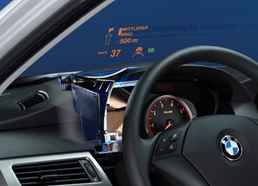
One of the main problems to solve with any automobile instrument or monitoring display is that the driver has to look away from the road to see the information. Also, in other cases, the driver does not look at the display, and therefore could miss an important warning such as low oil pressure. Many techniques can be used such as warning beepers or placing the instruments almost in view, but one of the most innovative is the head-up display (HUD). This was originally developed by the aircraft industry for fighter pilots; aircraft designers had similar problems in displaying up to 100 different warning devices in an aircraft cockpit. Figure 1 shows the principle of a head-up display and figure 2 shows a system in a BMW. Information from a display projector is directed onto a partially reflecting ‘mirror’. The information displayed projected would therefore have to be reversed for this system. Under normal circumstances the driver would be able to see the road through the screen. The brightness of the display is adjusted to suit ambient lighting conditions. A great deal of data can be presented when this system is computer controlled.

A problem, however, is which information to provide in this way. The speedometer could form part of a lower level display and a low oil pressure could cause a flash right in front of the driver. A visual warning could also be displayed when forward-facing radar detects an impending collision. Current HUD systems are for straight-ahead vision, but liquid crystal rear view mirrors, used to dim and cut headlight glare automatically, can be used as an effective display screen for rear facing, blind spot detecting radar.

image

1.Head-up display operation

image

2. HUD example (Source: BMW)

One interesting study is to determine exactly where the driver is looking at any point in time, which could be used to determine where the head-up display would be projected at any particular time. The technique involves tiny video cameras, coupled to a laser beam that reflects from the cornea of the driver’s eye and can measure exactly where he or she is looking. Apart from its use in research, the eye motion detector is one of a series of tools used in bio-mechanical research that can directly monitor the physical well-being of the driver. Some of these tools could eventually be used actively to control the car or to wake up a driver who is at risk of falling asleep.


MOST

MOST – Home > Technology > Introduction

Automobiles have evolved from having a simple radio with perhaps a cassette or CD player to having a variety of sophisticated entertainment and information systems that need to communicate and interact with each other and with a human user. As a matter of fact, automotive systems are more feature-rich than many other A/V applications such as home A/V distribution, security A/V systems and industrial applications. MOST offers an optimized architecture for the real-time transport of audio, video, data and control. It is the backbone of modern infotainment systems.